
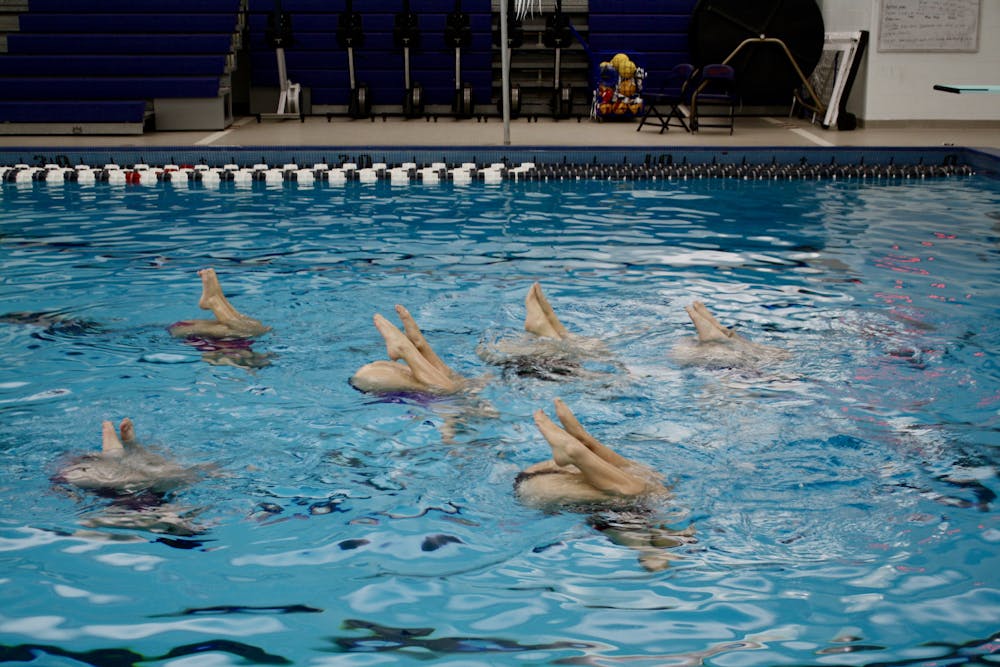
The sounds of water lapping echo off the walls of the Weinstein Recreation Center. It’s mixed with the pounding verses of Britney Spears’ “Toxic” and the shouts of synchronized swimming coach Caroline Weist as she counted the beats. In the pool, six swimmers in goggles, caps and nose clips twisted, turned and propelled themselves through the water.
Weist paused the music when the routine came to an end. She stood at the edge of the pool and gave constructive criticism. She said movements need to be sharpened. Some swimmers needed to hit their counts better while others needed to travel across the pool more.
“Let’s try it again, and this time I’ll film it,” Weist said. The swimmers nodded and moved back into position. They started practice at 7:30 p.m., and had been treading in 12 feet of water for over an hour. The swimmers never stopped moving and rarely touched the bottom of the pool.
Yet, there are no signs of exhaustion and no complaints of tiredness. They shifted back into formation, ready to begin the routine from the top.
The University of Richmond Synchronized Swimming team has a long history on campus. It was started in the mid-60s, according to the team website, and was originally a Division 1 team.” In 1987, the team made waves when it placed third in the Collegiate Nationals, making it the highest ranked Division 1 team in UR history at that time.
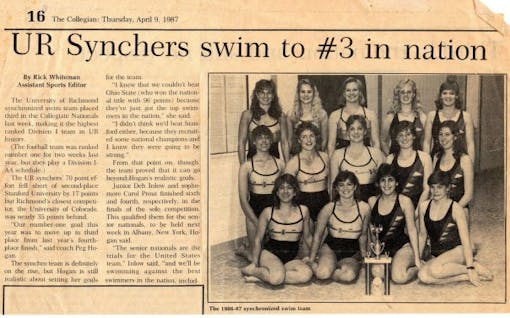
Then, UR promoted the women’s golf team to varsity status, and the synchro team was chosen to drop to club team status, according to an article in the Collegian's archives.
Weist said that UR gave the team transitional funding to continue the program, but that much of the funding today comes from continuous financial support from alumni.
Weist is UR alum, ‘05, and now is an assistant professor of German studies at UR. She returned to teach in 2016, and decided to coach as well.
She said that an enduring connection to the sport is why she wanted to keep coaching – and why alumni continue to give, even decades later.
She said that in the early years: “...it was a time when there weren't groups like this so much for women, and it was like a place where you could be strong and supported by other women.”
Enjoy what you're reading?
Signup for our newsletter
The other two synchro coaches are also alumni. Erin Wheeler, ‘18, and Caterina Erdas, ‘22, echoed Weist’s sentiment of a strong connection formed within the team. Like Weist, both women hope to continue the synchronized swimming legacy at UR .
“I just had such a great experience [on the team] and I was living in the area. So when one of the coaches was leaving and I knew the team needed some help, I offered the help because I wanted more girls to have the experience I did,” Erdas said.
According to Erdas and Wheeler, one of the most exciting parts of coaching this year is the influx of new swimmers who joined the team.
“ This is the first year in over a decade that we've had so many new people who are all joining at the same time,” Wheeler said. “They're all freshmen and since it's something new for them, they are really passionate and excited about it in a way that people who have swum for a long time don't feel.”
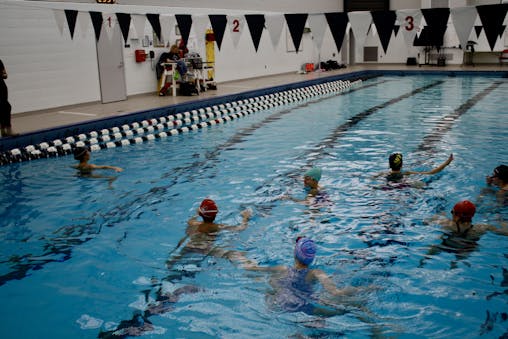
Four first-years, one sophomore and one senior make up the synchronized swimming team this year. None of the first-year students who joined had any experience in synchro, but they said they were searching for a fulfilling activity with a strong sense of community, and found it on the team.
First-year Kola Liu was looking for a competitive speed swimming team to join, but was recruited by the synchronized swimming team at SpiderFest. Liu said that synchronized swimming turned out to be more interesting for her.
First-year Katie Metz was also recruited at SpiderFest.
“They said, ‘Come, if anything, it'll be a good workout’, and I was like, ‘I'll do it for a story to tell,’ you know. So I did it, and I really enjoyed all the people here and it's another niche interest of mine,” Metz said.
Metz was on a swim team in her younger years and is comfortable in the water. Still, she said, a lot of work went into building up the stamina for synchronized swimming.
“Lots of drill practices in the water that I didn't like doing, but are good for me, and it's good for building lots of stamina,” Metz said. “Especially being able to hold your breath underwater is really important and just doing a lot of specialized skills, specifically for synchronized swimming.”
Synchronized swimming doesn’t only require strength and stamina. It’s a dance within the water. Flexibility, grace and rhythm are also necessary to twirl, twist and lift in time with the music.
“I had never done anything with like eight counts or anything like that before, so that was huge,” said first-year Sophie Berling, who was comfortable in deep water, but had to learn rhythm and cadence when she joined the team. “It was definitely a big learning curve, but it was really really fun. I love it.”
Liu, Metz and Berling said that the coaches and community made them feel welcome in an unfamiliar sport. Sophomore Kim Straker is an Australian exchange student who also found community in the team.
“The team has been just amazing," Straker said. “We had a lot of fun just learning together and doing this new experience – and it was [a] great opportunity for me to meet new people as well here.”
The synchronized swimming team is preparing for two events in the spring semester. In February, they will perform their routine at UR for community members and other small synchronized swimming teams. In March, they will compete at Stanford, performing a mash-up of Brittany Spears songs.
As the swimmers geared up for another run of their routine, Weist pulled out her phone to record. The music played once again over the speakers, and the swimmers launched into their act. With just a few of Weist’s comments implemented, vast improvements were made. Movements were sharper, more rhythmic and the swimmers glided further from one end of the pool to the other.
Erdas said that seeing such tangible progress in the swimmers was one of her favorite parts of coaching.
“I love coaching, like people who are new, just so like, you can see vicariously through them, them improving, and it’s just so rewarding for them as well,” Erdas said.
Contact lifestyle editor Sophie Dulog at sophie.dulog@richmond.edu
Support independent student media
You can make a tax-deductible donation by clicking the button below, which takes you to our secure PayPal account. The page is set up to receive contributions in whatever amount you designate. We look forward to using the money we raise to further our mission of providing honest and accurate information to students, faculty, staff, alumni and others in the general public.
Donate NowRead More

Tiramisu and troublemaking tuxedo cats
By Lily Nipper and Sara Mancipe | Yesterday