
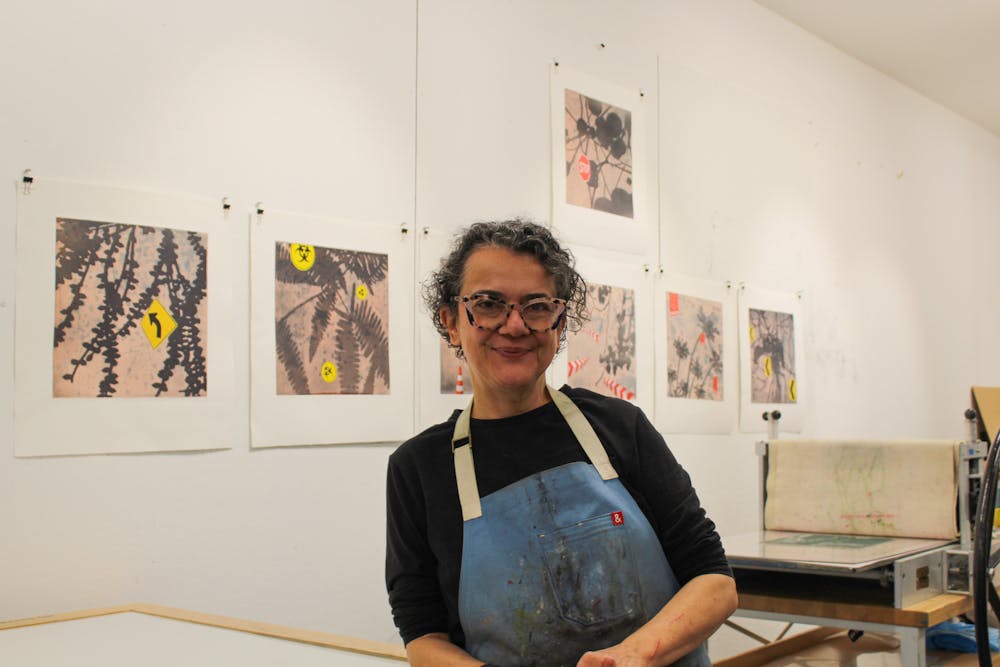
On a rainy Tuesday morning in the University of Richmond printmaking studio, art professor Tanja Softić, in her signature worn-in apron, eagerly assisted students as they etched designs and rolled vibrant ink on linoleum plates.
As first-year Ella Fox explained the intricate process of carving linoleum, Softić chimed in from across the table: “Fun fact – linoleum was invented by the U.S. Navy for the floors of ships.”
Amid the stacks of multi-colored layered prints, turning wheels and levers on clunky printing machinery and students seeking input, professor Softić maintained an effortless rhythm in the chaos.
“I’ve never met someone more passionate about paper in my life,” said senior Nina Lavelle.
Softić, a Bosnian-American artist and professor at UR since 2000, earned an undergraduate degree from the Academy of Fine Arts at the University of Sarajevo and an M.F.A in printmaking from Old Dominion University.
“I don't remember a time in my life where I didn't want to be an artist,” she said.
Softić’s unique personal experiences have influenced her both positively and negatively, she explained. When she moved to the U.S. in 1989, she was unaware that her home country would soon be divided into eight separate countries.
“I have this before and after, you know, break in my life that has defined me so much,” Softić said. “But then again, if you think about it, everybody does. It may not be immigration or loss of the country, but it's something.”
Softić said that she grew up in a relatively patriarchal society, which made it challenging to envision herself in academia. She said it was clear that women were in a second-rate position, as, despite their accomplishments, they were rarely promoted or recognized in their careers.
As a result, Softić never considered teaching art until graduate school.
Jill Zevenbergen, a visiting lecturer of art and colleague of Softić’s, said Softić puts a lot of her personal history into her work and her new collection combines that history with the current political climate.
Enjoy what you're reading?
Signup for our newsletter
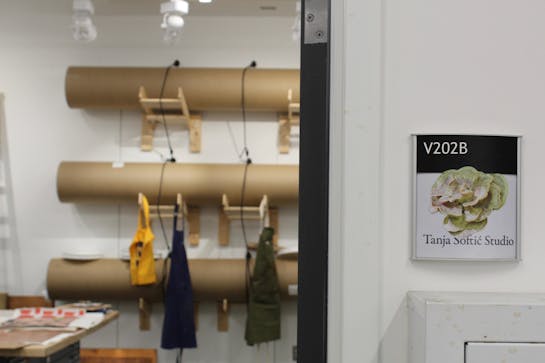
Zevenbergen and Softić created a studio community where they serve as resources for students in their classes, collaborating and pushing each other by sharing technical skills and processes in their respective areas of expertise.
“I’m watching her tackle this whole new portfolio of work, and she’s in here every day,” Zevenbergen said. “Present all the time, and yet, she’s always willing to help a student at the same time.”
Softić explained that as she began teaching, she had to program herself out of the assumption that everybody is wildly interested in visual art. She found that the balancing act of teaching is an art in itself.
Former student and senior Charis Baumann said her favorite part about Softić’s class was the creativity she transferred from her own work to her teaching style.
“Her studio was, like, right next to our classroom, so we could kind of peep in there and see what she was working on,” Baumann said. “And her stuff is really awesome and really inspirational.”
Softić said the biggest challenge as an artist is finding time and space, and everything else can be figured out. While time is a changing factor, she said she has found her “space” in the UR print studio and her home studio.
Softić describes her work as political abstraction. It represents the way we interact with the natural world, often including mushrooms and plants in the design. She explained that it is an astonishing time, and her work reflects that astonishment.
“Print, specifically in Intaglio or etching, is kind of my main jam,” Softić said.
She explained she created her most recent collection using the labor-intensive process of drawing, cutting, collaging and editing different media. Softić considers herself an “art-on-paper” artist, and many students testified to her passion for the medium.
“Printmaking is, like, life for her,” Fox said. While working on a project using Japanese paper selected by Softić, Fox explained that Softić is extremely knowledgeable about the history of paper and printmaking materials, having traveled extensively across the globe.
In a bright, airy studio where students work at their own pace to develop their creative ideas, Softić is involved in each step of their processes.
Softić fosters student ideas and encourages them to go down whatever path they desire when they have a vision for something, Lavelle said.
“There's nothing better than seeing a student who has that feeling like, wow, I surprised myself. I made this, you know, and it's better than I thought it would be,” Softić said. “The older I get… I just like being around the energy, that kind of a wonderful, youthful everything-is-possible energy, because it kind of keeps my kid inside alive.”
Softić said that she is in communication with local galleries and hopes to showcase her newest collection to the wider community in 2026.
Contact visual editor Gillian Morano at gillian.morano@richmond.edu
Support independent student media
You can make a tax-deductible donation by clicking the button below, which takes you to our secure PayPal account. The page is set up to receive contributions in whatever amount you designate. We look forward to using the money we raise to further our mission of providing honest and accurate information to students, faculty, staff, alumni and others in the general public.
Donate NowRead More
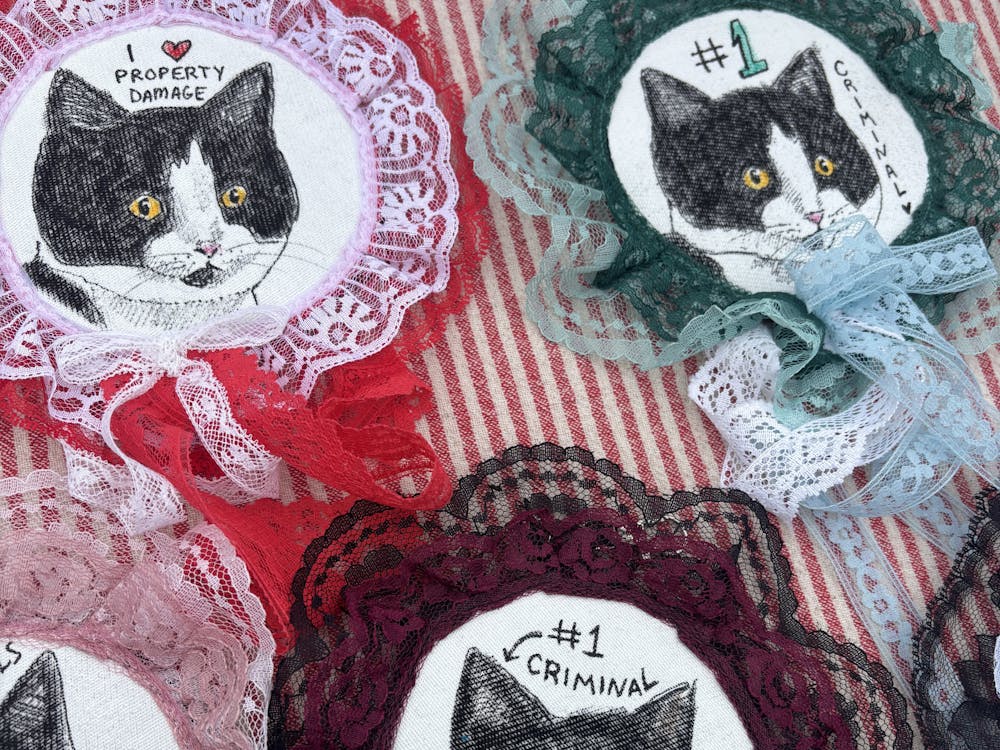
Tiramisu and troublemaking tuxedo cats
By Lily Nipper and Sara Mancipe | Yesterday