
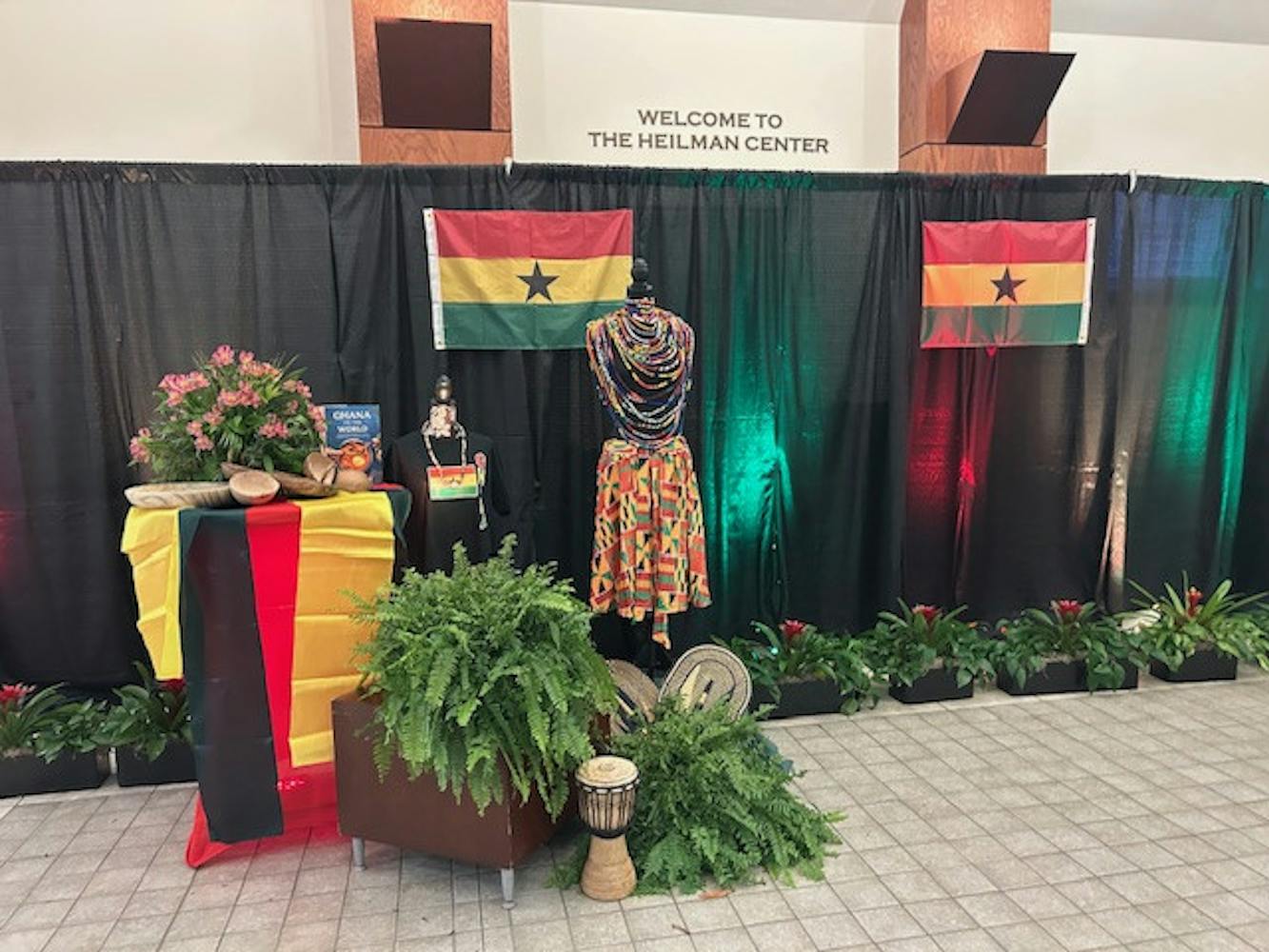
It was a Wednesday evening unlike any other. The Heilman Dining Center’s standard beige and gray walls were accented with kente cloth, featuring red, gold, and green. The sound of live African drums replaced the usual generic pop music that played on the speakers. Stations that routinely served meatloaf and mashed potatoes instead had cassava fries and banana fritters.
It was a part of the 10th annual University of Richmond International Education Week. This year’s theme was Ghana, which featured a performance by a famous Hiplife star, a talk by a Pulitzer Center-funded investigative journalist and a kente cloth exhibition.
The dinner on Nov. 19 comprised a full week of cultural and informational sharing. It highlighted traditional Ghanaian recipes. From the tablecloths to the condiments, the dinner, like the week, was almost a year in the making, made possible through collaboration between students, faculty, staff and outside professionals with special knowledge about Ghana.
“For me, the most important part of IE Week is the connections that emerge among people who share a common interest in a place,” Dean of Global Engagement, Martha Merritt, said. Every year for IE Week, which Merritt helped initiate at UR in 2017, the Center for Global Engagement chooses a different country to focus on and celebrate.
“I’ve loved seeing students' faces light up when their country of origin is featured. I think those students walk around campus all week feeling empowered. Suddenly, everyone really understands where Ghana or Denmark or other countries we’ve visited in the past are located on a map.”
Ghana Week began on Monday, Nov. 17, with a Ghanaian breakfast at the dining hall. The main feature was toasted coconut millet porridge, also known as Hausa Koko, a spiced porridge made from millet, ginger, pepper and spices. Other dishes included sugar bread rolls, fried plantain and puff puff.
The sugar bread rolls were freshman Nidhi Karnik's favorite. She said she enjoyed reading the brief descriptions that went with each dish.
“It’s not just about trying the food, but actually learning about where it comes from and the heritage,” she said.
Learning through breaking bread was Chef Andy Kerscher’s primary goal when planning the various menus for Ghana Week.
“We [dining services] are a place of education,” Kerscher, interim Executive Chef and Chef de Cuisine of Dining Services, said. “So though I might not be teaching you about economics, I can teach you about food, and I can teach culture through food.”
Kerscher said he and his team had a heavy hand in the production of each special event hosted at the dining hall, including the “Lunch Beverage Display” on Tuesday, Nov. 18. The display featured specialty Ghanaian drinks such as Sobolo, a Hibiscus drink, and Atadwe, a tiger nut milk drink.
Sophomore Manuela Bonzo, who was born in neighboring Côte d'Ivoire, found many similarities between Ghanaian cuisine and her own.
Enjoy what you're reading?
Signup for our newsletter
“I think what makes these events powerful and nice is the complete immersion in the culture with the decor,” Bonzo said. She said the dining staff’s outfits and the live drumming added to the excitement of the dinner.
Kerscher said his team worked alongside a committee of majority Ghanaian community members to maintain authentic flavors.
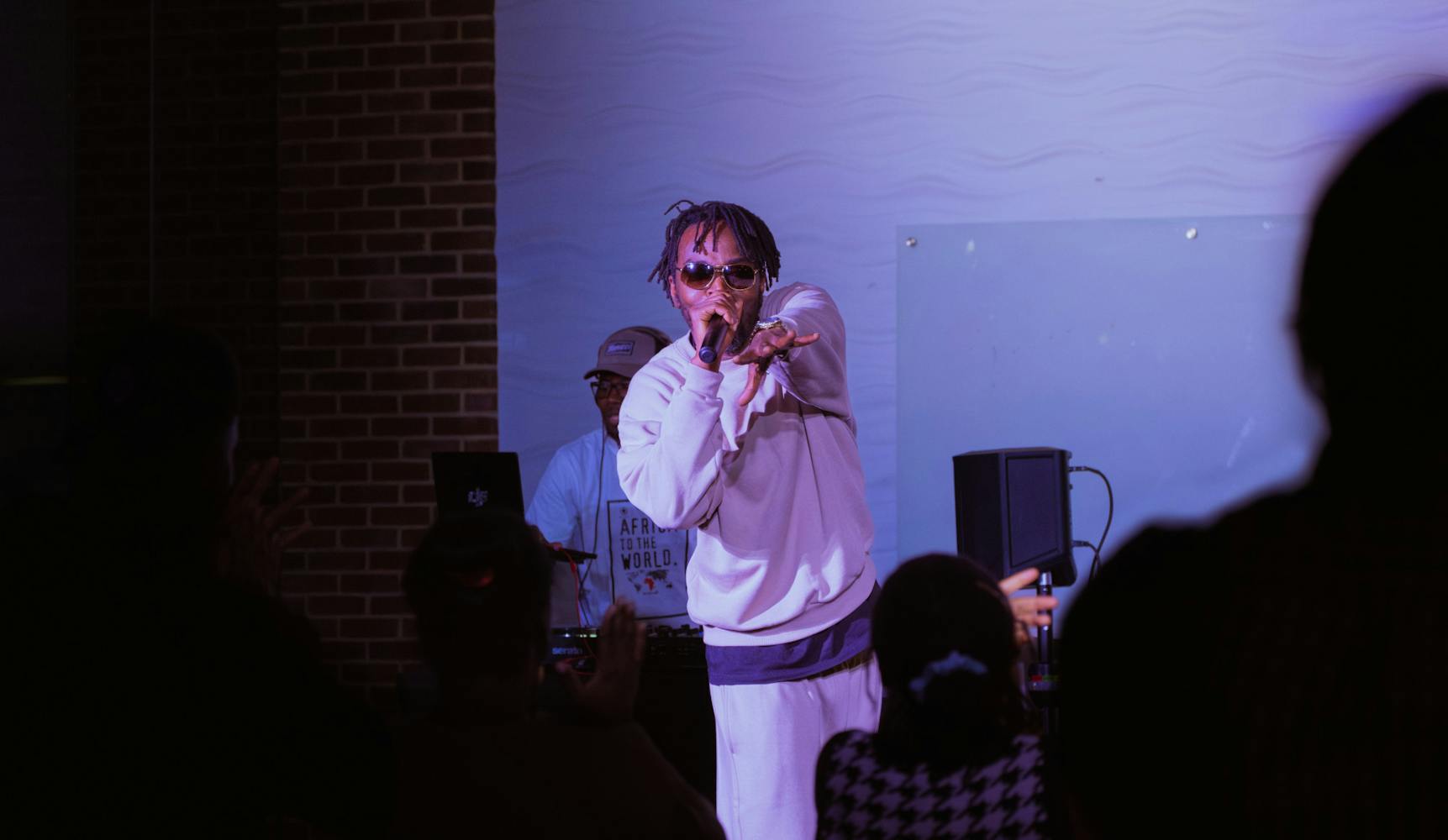
The Tuesday night attraction was Ghanaian Hiplife artist Kwaw Kese. Kese has over 13,000 monthly listeners on Spotify and is known for his energetic stage presence.
Before performing, Kese discussed the evolution of his 22-year music career and explained his artistry.
Hiplife is a blend of hip hop and high life, a style of West African dance music. Hiplife is often rapped in a local Ghanaian language and incorporates traditional Ghanaian instruments into hip-hop beats.
“Hip hop in Ghana is not violent. We don’t shoot guns, we preach peace,” Kese said. “We use hip hop to address societal issues that need to be addressed.”
Kese has collaborated with other artists across Africa and the Atlantic, including songs with American rapper Memphis Bleek and Nigerian singer-songwriter Brymo.
Many in the audience swayed and sang along as Kese rapped his most popular hits.
“Had some mad fun inside the University of Richmond with students and management,” Kese wrote on his Instagram following the event. “Glad to have put smiles on some Ghanaian students who have been missing home. Let’s do this again soon.”
Junior Yvonne Donkor, who is from Ghana, said, “It really makes me feel like home this week, seeing people who are not just me here, but other people, prominent people like the talk today, the people that came here to portray Ghana, to students here and also to faculty.”
Before Kese’s performance, Richard Dzikunu, a United Nations award-winning reproductive health specialist, gave a talk titled, “Health, Hope, and the Power of Young People in Ghana: Centering Rights and Justice in Tomorrow’s Health Leadership.” He is currently the Senior Programme Officer at YIELD Hub.
Dean Merritt drew in the broader African community on campus, including Assistant Professor of Health Studies, Dr. Nigel James, from Zimbabwe. He said he hopes the focus on Ghana would re-engage students in international travel to his continent, which he said had been interrupted by COVID-19.
“By focusing on Ghana this time around, it's a re-engagement effort, a strategic re-engagement effort, from our side of the university, to reintroduce our students to places like Ghana as good destinations for cultural exchange,” James said.
Dr. Wunpini Mohammed, a professor from Cornell University and author of “Media, Culture, and Decolonization: Re-righting the Subaltern Histories of Ghana”, gave a talk on Wednesday entitled “Challenging African stereotypes one story at a time.” She said Western media tropes about Africans have been challenged in recent years through films like “Black Panther” and Beyoncé’s “Black is King” album.
“Black Panther disrupted this notion, you know, a majority black cast in a movie sold better than Hollywood could ever possibly imagine. Then after that, we began to see representations of other communities, and also the commitment from Hollywood to support the telling of stories about communities that historically had been marginalized,” Mohammed, who is from Northern Ghana, said.
She said she joined UR’s Ghana Week because her country “has systematically been erased from national and global narratives,” and she wanted “to come here and share with the people of Richmond” compelling aspects of Ghana.
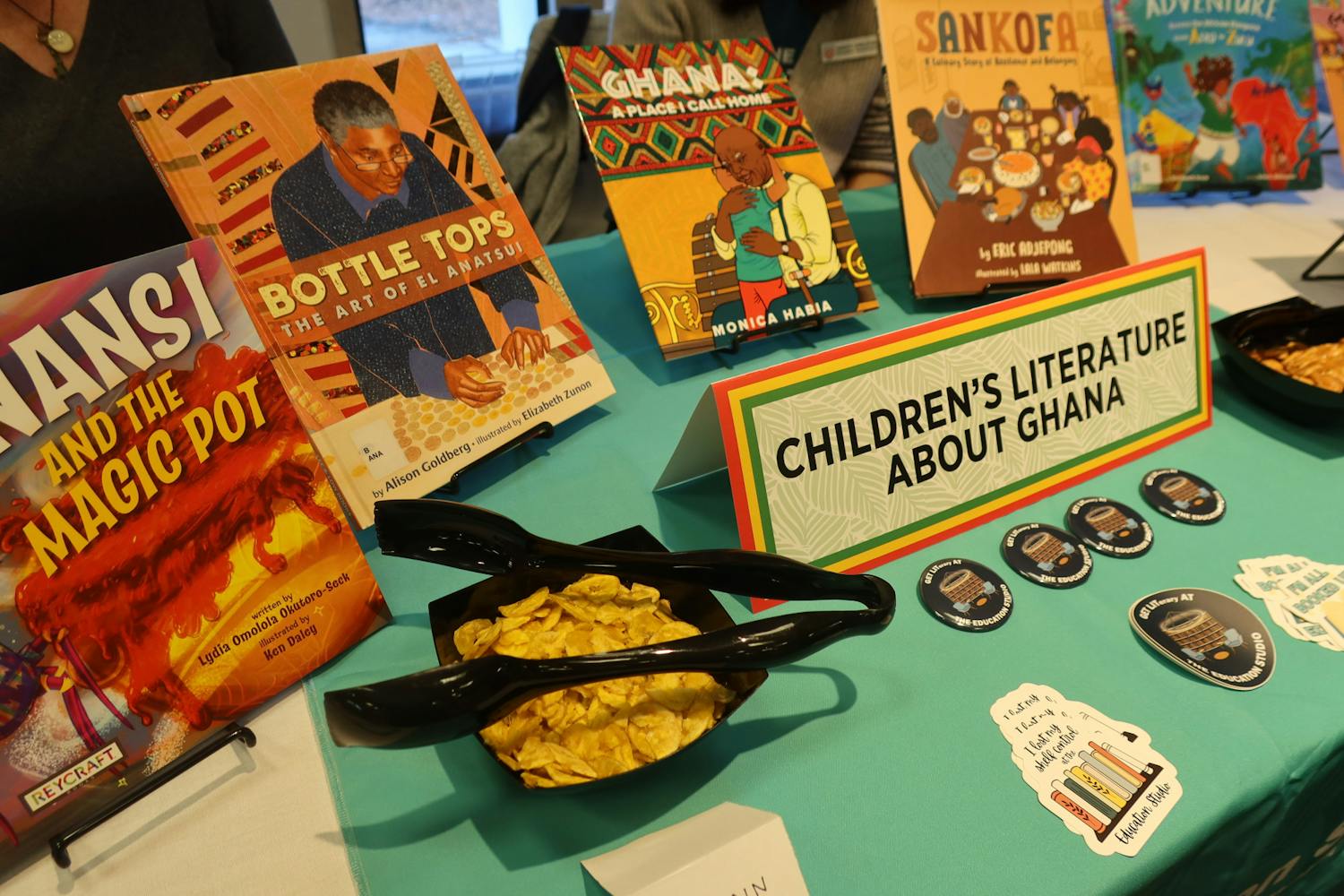
Mohammed also participated in the IE Week Ghana Fair, which was held in Tyler Haynes Commons late Wednesday afternoon. Each of the fair’s 15 tables explored diverse aspects of Ghanaian culture and life, including art, music, education and geography.
One table included a research project by UR health studies students on breast cancer screening in rural Ghana, and another table presented the mythology and iconography of kente cloth.
Ghana Week concluded in the Gottwald Auditorium on Thursday, Nov. 20, with a virtual presentation from journalist and co-founder of Ghanaian news outlet, iWatchAfrica, Gideon Sarpong. He discussed two substantial reports he conducted, which were supported by the Pulitzer Center. One was an undercover investigation into the sea turtle poaching crisis in Ghana, and the other exposed European Union vessels illegally decimating local fish stocks.
He emphasized the importance of journalism, noting that his report on the sea turtles led to the arrest of the poachers. “Who will tell these stories? I have done my part for sea turtles in Ghana, and I will keep doing it, but we need more. We need more journalists to keep telling these stories,” Sarpong said.
Dean Merritt attended most of the week’s events.
“People love sharing their culture, so my office can help the reach of that sharing,” she said. “We hope that UR’s version of IE Week helps people understand the complexity of the world around them and helps them empathize with people who come from a place very different from their own.”
Contact features editor Grace Randolph at grace.randolph@richmond.edu and features writer Grayson Casey at grayson.casey@richmond.edu
Support independent student media
You can make a tax-deductible donation by clicking the button below, which takes you to our secure PayPal account. The page is set up to receive contributions in whatever amount you designate. We look forward to using the money we raise to further our mission of providing honest and accurate information to students, faculty, staff, alumni and others in the general public.
Donate NowRead More
Tiramisu and troublemaking tuxedo cats
By Lily Nipper and Sara Mancipe | Yesterday