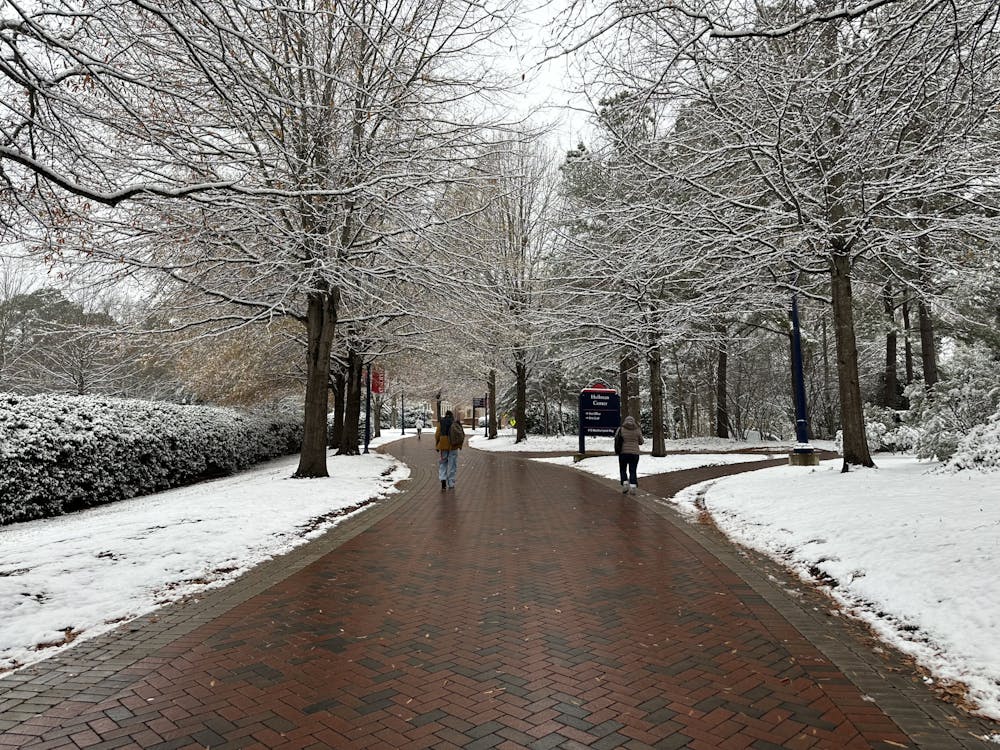
Virginia is known for its rolling hills and diverse landscape, and the University of Richmond is no exception. For students with physical disabilities, there can be challenges in navigating campus’s tricky terrain.
UR accommodates many of the accessibility needs of students, staff and faculty, but due to the campus layout and a lack of easily accessible information, some needs are still unmet.
Director of Disability Services Cort Schneider explained that for some people with physical disabilities, the topography of campus can make mobility difficult.
“A lot of the inaccessibility of the campus has to do with the topography,” he said. “I joke that there's only two flat places outside on this campus. It's the football stadium and the intramural stadium.”
“Mount Modlin,” what some students call the uphill trek from the Heilman Dining Center to the Modlin Center for the Arts, is just one of UR’s topographical battles. And for students like junior Rhiannon Harris, who receives accommodations through Disability Services, accessibility issues still arise.
Harris has a connective tissue disorder that resulted in a spinal injury and limited mobility. She reached out to Disability Services to get a Y pass, a temporary accommodation that allows students to park their vehicle in any student parking lot, according to the UR’s Parking Services website. She also has an ADA permit from her doctor which allows her to use all lots, including staff parking.
“The school is a pretty hilly campus so it is hard to get around,” Harris said. “Before I had the Y pass through the school, getting to and from class was extremely difficult.”
Harris was referred to Disability Services by her dean and needed to provide proper documentation of her injury to receive accommodations.
“The process of getting accommodations was a little more difficult than it could be,” Harris said. “I understand that you do need to provide some form of proof in order to access that service, so, it was manageable, but it could be easier. I just didn't know what was available to me at the time.”
Harris has also had difficulties using her ADA pass on campus. She was denied parking in a staff lot by the dining hall during move-in day by RMC Events security, which UR outsources to for campus events.
“It’s not necessarily Disability Services’ fault that I got denied, but rather the lack of education of parking services or RMC events that was working that day,” she said.
Schneider has hopes for improving accessibility on campus in terms of transportation and mobility.
Enjoy what you're reading?
Signup for our newsletter
“In a dream world, I would love to see an on-campus shuttle,” he said.
Although the university provides the campus loop shuttle, it only runs from 8 p.m. to 12 a.m. on weekdays, according to the university website. Schneider would like to see a bus that runs throughout the day.
He also spoke about the university’s long-term plans for improved accessibility.
“I genuinely think facilities is really committed to a long-term plan to make the campus more accessible,” Schneider said, “but it's not going to happen overnight.”
One example of a long-term change that has been made on campus is the zigzag walkway in front of the library.
“When I got here, the path that now exists at the front of the library did not exist,” Schneider said. “There was no way outside to get from the bottom of the library to the top. If you were disabled and you couldn't do stairs, you had to go through [Tyler Haynes Commons].”
Disability Services serves around 600 students with a variety of disabilities, most of them invisible, meaning you wouldn’t see a disability upon first glance, Schneider said. The department works with many offices at UR, including Parking and Dining services and the Office of Residence Life and Housing.
First-year Imre Barna applied for accommodations at UR after getting diagnosed with ADHD. She said the process of receiving accommodations was relatively simple — she had the proper documentation and diagnosis before coming here.
“I think for students that haven't had accommodations before and haven't gotten a diagnosis, it would be a lot harder for them, because then they would have to find someone to get them a diagnosis, or go through [Counseling and Psychological Services], and that's a long process,” Barna said.
According to Schneider, CAPS has expanded its staffing and services available to students, including ADHD testing. But Barna said most students are unaware of the resources available to them.
“I think there should be more exposure because I didn't even know what accommodations I could get,” she said. “There's not a list online that says you can get these things. I think they should probably be more accessible for people.”
Schneider emphasized UR’s commitment to its students and the continued expansion of Disability Services.
“It’s going to take a village. It's going to take a lot of offices to think through, ‘how do we do this?’” he said. “That’s one thing that I know that Richmond is committed to.”
Contact news writer Addy Gove at addy.gove@richmond.edu
Lifestyle editor Blake Ryan contributed to reporting.
Support independent student media
You can make a tax-deductible donation by clicking the button below, which takes you to our secure PayPal account. The page is set up to receive contributions in whatever amount you designate. We look forward to using the money we raise to further our mission of providing honest and accurate information to students, faculty, staff, alumni and others in the general public.
Donate Now