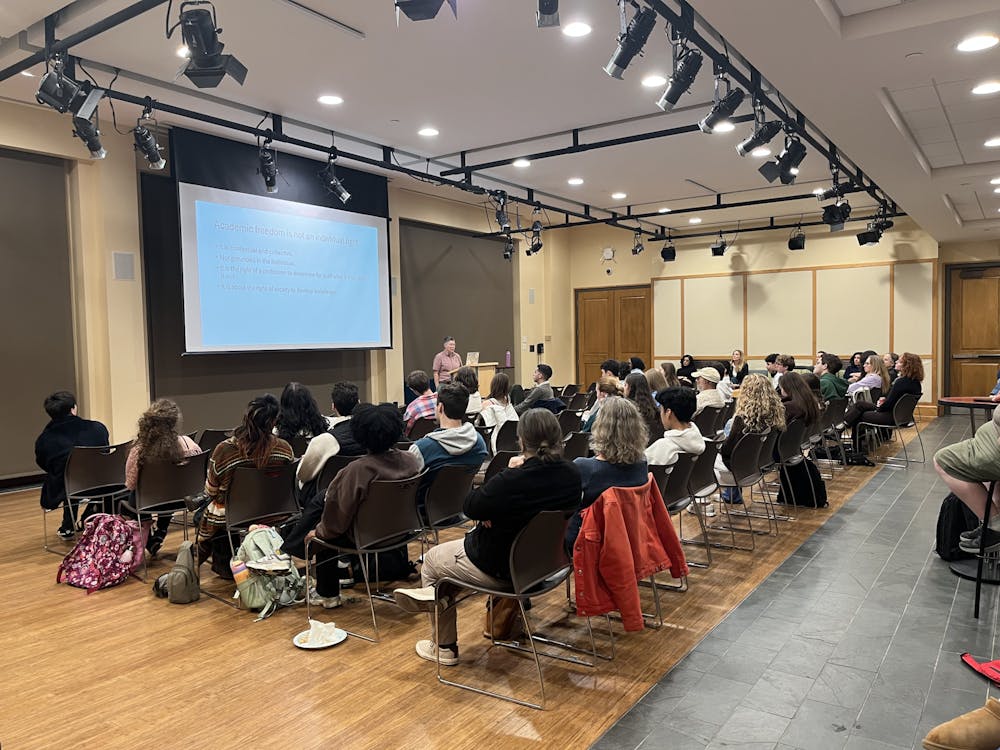
Over 40 students and faculty at the University of Richmond gathered Thursday, Nov. 13 for a discussion on the impact of rising political pressures on academic freedom.
At a discussion titled “Universities Under Attack And What That Means For You,” participants gathered in the Carole Weinstein International Center commons to hear from history professor Pippa Holloway and leadership studies professor Volha Chykina, as they explored the importance of academic freedom for professors and its impacts on the quality of higher education.
The talk was hosted by political science professor Dana El Kurd, with support from the political science and history departments and the University of Richmond chapter of the American Association of University Professors.
The event opened with short lectures, with each professor offering a different perspective on how political discourse shapes the level of academic freedom faculty experience.
“I'm hoping it now makes more sense to you why some of the attacks that are happening on universities are not just kind of wrong,” Holloway said. “But actually or potentially undermining what universities have contributed to our country and to the world over the past century.”.
Holloway talked about the function of academic freedom in the classroom and in research, and the protections that professors are guaranteed under AAUP principles, which guide the University of Richmond’s own faculty handbook. Holloway centered her argument on distinguishing between the freedom of speech and academic freedom.
“Free speech is your individual right to say whatever you want, while academic freedom's goal is to develop a series of experts that teach you and conduct research,” she said.
Holloway explored the significance of allowing professors to continue their research and to dictate their own curriculum as experts within their departments rather than allowing the government to make those decisions. She said that, even with free speech protections, professors are held to professional standards and are continually evaluated by university administrators and experts in their fields.
“If I'm a terrible historian, it'll be other historians that tell us that, not the governor or the state legislature,” she said.
Chykina opened the second half of the event and presented on the incursions on academic freedom globally and their impacts on scientific research and the future of the field of science. Drawing from her own research, Chykina said that there was a correlation between the rise of populism and a decrease in academic freedom. Drawing comparisons with Holloway’s discussion, she said that this was an effect seen globally, not just in the United States.
“Universities in many ways are becoming a scapegoat that these anti-academic feelings could be mobilized by populist leaders to build a coalition,” she said.
Chykina talked about the importance of allowing academic freedom in research, even in institutions that aren’t designated as research universities. She said that such freedom fosters national and global collaboration by building connections between academic institutions.
Enjoy what you're reading?
Signup for our newsletter
“It's harder for professors now to collaborate across the country…so what we argue there is that this critical research would be thwarted by the decreases in academic freedom,” Chykina said.
Their presentations were followed by an unmoderated discussion, opening the floor for students to ask questions and push the conversation further.
Junior Adam Kasti asked a question about the university’s response to federal pressure, noting that some institutions are choosing to “lay low” to still be able to provide resources to students.
In response, Holloway said private universities like UR are “in a safer position than a lot of local universities,” but still face real risks. She said that some professors worry about what might happen if their research or public comments attract backlash.
“If we get in the public spotlight, maybe 1,000 letters come from some private organization to the university and say, ‘Fire Dr. Holloway,’” she said. “If they got 10,000 emails about me, if President Trump starts talking about me, those are not entirely out of the question.”
El Kurd agreed, noting that faculty concerns often mirror the pressures felt across the institution.
“There's definitely an emphasis on compliance, whether it's on the administrative level or the professor's level,” she said.
After the event, many students said they felt this event helped them better understand how political pressure ultimately shapes their own learning experience.
Kasti said he learned a lot from the conversation, which added more perspective to the impact of federal policies on academic institutions.
“I wanted to attend because this affects the university as a whole and the country as a whole,” he said.
Huda Elsadig, a first-year student, said that the event helped give her a clearer grasp on the impacts of political scrutiny on the national education system.
“It was very eye-opening learning about the differences in freedom of speech and academic freedom and how governments globally are trying to encroach on academic freedom as they transition into authoritarian-like regimes,” she said.
While their presentations highlighted the dangers of restricting academic freedom and its effects on education and research worldwide, a note of hope remained. When asked how academic freedom is protected at the University of Richmond, Holloway said that the university’s commitment gave her confidence.
“The way you get a high-quality education is by being taught by experts in the field who have academic freedom,” she said.
Contact multimedia director Gareth Woo at gareth.woo@richmond.edu and writer Melanie Castillo at melanie.castillo@richmond.edu
Support independent student media
You can make a tax-deductible donation by clicking the button below, which takes you to our secure PayPal account. The page is set up to receive contributions in whatever amount you designate. We look forward to using the money we raise to further our mission of providing honest and accurate information to students, faculty, staff, alumni and others in the general public.
Donate NowRead More
Weekly Round-Up | Week of Dec. 1
By Sophie Dulog | Yesterday
Sweeney’s season high: Richmond’s win over Navy
By Farah Šertović | November 25, 2025