
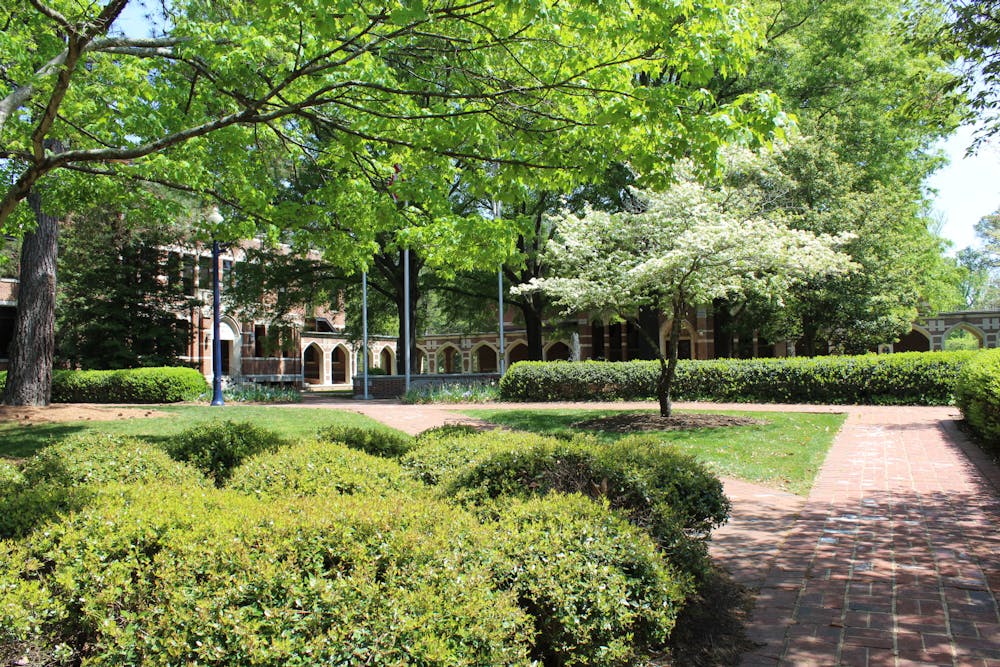
Many students are drawn to the University of Richmond’s beautiful campus, which is nationally recognized and ranked No. 1 most beautiful campus in 2023, No.2 in 2024 and No. 22 in 2025.
“I’m really thankful to be in such a relaxing and inspiring environment,” said sophomore Chris Kim. Senior Eric Waligora said UR’s colorful and nature-filled campus helps create a peaceful environment that can help them relieve stress after a long day.
“The fact that I can walk past plants when I go to class helps me relieve stress,” Waligora said. “I love how the landscape complements the architecture.”
While most people admire what’s visible on the surface, few realize the amount of work that goes on behind the scenes to keep the campus so vibrant.
The university’s landscape services, part of University Facilities, manages everything from flowers and grass to trees, athletic fields and even the lake.
“We have about 25 people when fully staffed — six gardeners, one team lead, one supervisor, nine groundskeepers, two auto mechanics and other roles,” said Allison Moyer, associate director of landscape services and horticulturist.
Moyer explained that the landscape team makes an effort not to overlook details that should be taken care of.
“We've broken our campus up into six sections,” she said. “Each gardener gets a section, and every year, they move from section to section so that they don't get those blinders on.”
Their main responsibilities include mowing, tree and flower maintenance and installation, athletic field maintenance and setup, fleet management and maintenance, snow removal and management of Westhampton Lake.
The landscape services team maintains the 378-acre campus, including 170 acres of turf, 21 acres of parking lots, 2.5 acres of walkways and 16 formal flowerbeds.
“We’ll be planting 16,000 tulip bulbs [down from 25,000]”, said Moyer. The university follows a four-year rotation cycle for flowers, and the selection process involves the director of landscape decisions every year, customizing the annual flowers and placing the order before Thanksgiving.
Moyer said one of the things that drew her to the campus was the mature landscape.
Enjoy what you're reading?
Signup for our newsletter
“I love the care the university takes, even when building new buildings, to work around mature trees”, she said. “They don’t just clear-cut.”
The original plans to renovate North Court included cutting down a large sycamore tree, and after Moyer advocated against it, the design was reworked.
“There was this huge sycamore tree — the largest on campus. They were going to take it down, but I said, ‘This tree is worth saving.’ They worked the design to save that tree.”
Moyer emphasized that the university “tries to preserve what we can” and that in many places, landscape is an afterthought.
"But that's not the case here," Moyer said. "It's always a function of the building process."
When asked how the university keeps its grass so green, Moyer admitted that some chemical treatments are used — but only as a last resort.
“Prior to spraying, we do as much hand pulling and as many cultural techniques as we can do,” she said. “We do have to use some chemical treatments to keep up with it”.
Sustainability practices are especially important for Westhampton Lake. The team takes monthly water samples, cleans up litter and monitors aquatic weeds that appear in the lake to maintain its quality.
Currently, landscape services is working on a project to create a living shoreline, or using natural materials like plants, rocks or dirt to stabilize shorelines instead of structures like concrete walls, near the college roadside.
“Having a living shoreline is a lot more healthy for the lake, healthy for the wildlife,” said Moyer. “It still has a pocket for people to enjoy and fish, but also creates a habitat and helps improve the quality of the water.”
Landscape services also collaborates with the Office for Sustainability, especially on the Eco-Corridor.
“Having access to that nature all the time and letting it be available to where people live is very important,” said Joseph Day, natural areas steward. He said his role involves “increasing biodiversity, which goes hand in hand with removing invasive plants, stormwater management, and then of course recreation – getting people to use it.”
When choosing plants for the Eco-Corridor, Day considers several questions: “Are they regionally appropriate? Are they native to our area? Do they evolve here? Are they going to survive?”
He noted that while UR already has many natural areas, some could be more accessible, like cutting through trails, installing benches or outdoor classrooms.
“Instead of just taking one way to class, people could walk through a small patch of woods," Day said. "I think that kind of daily contact with nature brings people peace."
Day added that he hopes people can remember the nature on UR’s campus, even when they graduate and spread throughout the world.
“They can take some of that and those values with them to have, and then, wherever, whatever neighborhood they settle in, wherever that is, they say, ‘you know what? I want to live in a place that has abundant green space for my family and I.’”
He emphasized that he would also love to invite students to further participate in the volunteer activities and enjoy the Eco-Corridor.
“When a potential new student, a prospective student, comes on campus, a visitor, a parent, whoever, the landscape department makes that first impression,” Moyer said. “Before you have an opportunity to meet with the professors, before you have an opportunity to go and eat in the dining hall, we make that first impression.”
She reminds her team, “Even though we're not working with a student directly every day, we do make a big difference.”
Contact writer Michelle Roh at michelle.roh@richmond.edu
Support independent student media
You can make a tax-deductible donation by clicking the button below, which takes you to our secure PayPal account. The page is set up to receive contributions in whatever amount you designate. We look forward to using the money we raise to further our mission of providing honest and accurate information to students, faculty, staff, alumni and others in the general public.
Donate NowRead More


